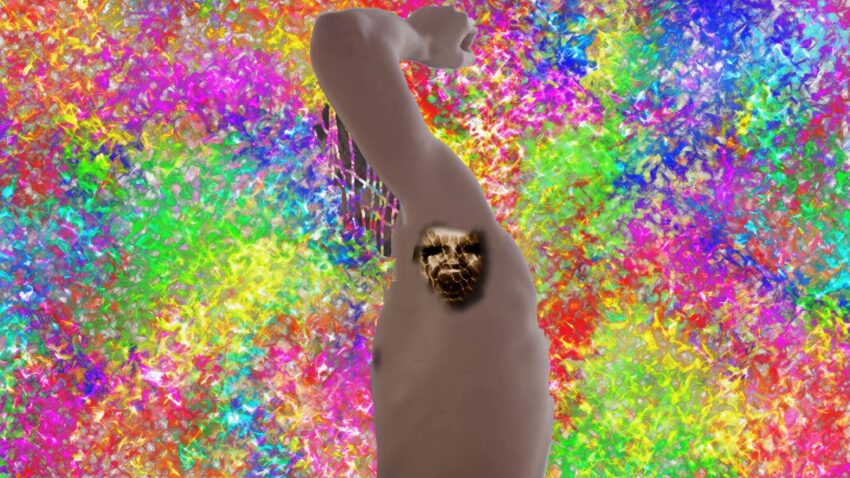
The lump in Steven’s armpit stayed the same size no matter how many times he told himself it wasn’t there. Staring at himself in the bathroom mirror. Bloodshot eyes wide and unblinking, taking in every detail. Cementing in his mind the moment everything changed. The bulb overhead flickering. One arm raised above his head, the other gasping tight the tumorous lump Steven willed into existence.
Not actively, though maybe so depending on your interpretation of reality. Steven didn’t normally believe in manifestation but at the moment anything and nothing is possible. It is entirely possible that the time spent paranoid about finding a tumor in his armpit caused his future to shift onto a path where it wasn’t just possible but inevitable. Then again this could all be a coincidence, a sign of how jumbled the chaotic spiderweb of fatelessness is.
Steven did not have time to settle this debate within himself. This was a medical emergency. There were people he had to contact.
God, what was his doctor’s number?
Steven doesn’t have to check to know the screen cracked. He’s intimately familiar with the sound. At one point in life he went through phones on a monthly basis thanks to a mixture of teenage angst, drug addiction, and a general desire to see everything burn. He’s left all that behind. He doesn’t throw his phone these days. But some situations demand force, demand violence, and does he want to spend his final days caring about a fucking phone?
The answer is yes. How else can he find help? He’d forgotten that his doctor had retired. One day a letter came in the mail and just like that he no longer had a doctor, twenty years of trust evaporating in a moment. Now he’s supposed to use an app he doesn’t understand to speak to a doctor he’s never seen before about his most vulnerable moment? Heart racing, stomach churning, anxiety holding a gun to the back of his head and still he tries to comply only to be put on perpetual hold, hours of his life dwindling away like sand between his fingers, moments lost forever, each representing a percentage, however small, of what little life he has left. Just thinking about it makes him want to break the phone all over again.
This anger is a defense. Steven can see that even as he gives in to it and stomps his foot down on the phone where it lays. The sound of grinding glass is unmistakable and utterly satisfying. So long as he can stay angry, he doesn’t have to think about the reality of dying.
Pacing the hallway from the kitchen to the bedroom.
He wanted a cigarette. A cigarette occupies the hands. A cigarette between two fingers isn’t just another object. It’s a mission, a purpose, a grounding. The smoke traveling down the throat, burning then numb, entering into the lungs, expanding, expanding, expanding only to contract and be expunged. Smoking is a task with a heartbeat of its own, a self-annihilating meditation.
But he’d given up smoking for health concerns.
He was gifted at giving up things. He quit smoking cold turkey one day, half a cigarette sitting in the ashtray on his desk. It sat there for two years, a trophy he kept until it felt unnecessary. He’d given up hard drugs, though he still thought highly of them and the times he had. Even if they fucked him up in the long run. He’d given up alcohol, though it never had a strong hold on him. He tried to give up diet Pepsi, but there was a limit to his power. Besides, a man needs a vice. It gives him a certain kind of strength, a certain kind of weakness. But what was the point? All that giving up and he still got his lump.
He slides his fingers up under his arm and probes gently. The solidity of it is startling. Feeling like a golf ball has been implanted beneath the skin. It’s larger than he thought when he discovered it though that’s hardly surprising considering his panic.
He doesn’t like touching it. Defining an object’s outline makes it real through its limitations. But that’s not it. Steven doesn’t like the way it squirms.
Steven comes to in the bathtub, blinking and squinting his eyes against the shower’s spray. The water is cold but his body’s used to it. He stretches out a leg and uses his foot to turn off the stream. He can remember getting into the shower, remembers sitting down, but has no recollection of passing out. He’s never been one for naps, but those he has announce themselves well ahead of time with a sluggishness that starts behind his eyes and moves out over his limbs. He’s never fallen asleep in the shower before either but it’s a time of new experiences.
His bong is where he remembers leaving it, on the floor next to the shower. He liked to take a couple rips before showering. For all the good it did him. Wasn’t weed supposed to prevent cancer? Wasn’t that a thing that went around the zeitgeist? It’s one of those quasi-facts kicking around in his mind, simultaneously true and false. Not that he particularly believed in it or any of the other rumors about the health benefits of marijuana. He spent enough time in the drug scene to understand its mythologizing. Everybody wants to believe their substance of choice offers semi-magical powers. But at the end of the day Steven was still just filling his lungs with smoke and that shit is always harmful. Not that this stops him from packing a bowl. Lighting it proves difficult. Holding his bong in his left arm, he tries to manipulate the lighter in his right but it doesn’t work. Despite repeated attempts, he can’t get enough pressure on the spark wheel to produce a flame. His thumb moves as he tells it but slower than normal. He takes the lighter with his left hand and transfers the bong to his left but it proves too heavy for his grip and falls tumbling to the floor. Steven’s eyes shut, teeth grinding in expectation of breaking glass, but none comes. The bong has survived unscathed though the weed has scattered everywhere.
Steven makes a fist with his right hand. It feels loose, weak. With effort he pulls himself up using the sides of the tub. He shakes like a dog before pulling the curtain open fully and stepping out. Throughout this extrication he has ignored the throbbing pain in his armpit, the weakness of his grip, and the fact that he can’t fully lower his arm, though this last piece has only just revealed itself, a wrecking ball aimed at the wall of nescience he has erected.
The mirror draws his attention. He wipes the condensation from the glass slowly, the movement almost a still image, a delaying tactic neither considered nor deployed but simply arising. The squirming feeling like a thousand itches, a cat kneading at his flesh from the inside, and there, in the mirror, shown so clearly, the lump has grown, protruding now like his Adam’s apple, and there, he can’t unsee it, are the features of an embryonic face, primordial, germinal, but unmistakable.
The mirror, like the phone, is shattered. It’s becoming a home of broken things, pieces scattered about and left lingering along the floorboards to collect dust. Not that either is needed. The desire to see himself has long left Steven, though a gentle voice may be a soothing stimuli. He feels himself reduced to thus: a series of stimuli; a strange loop that repeats itself eating shitting sleeping; the most basic of animal behaviors.
He scratches at his patchy beard with his working hand and thinks about his mother and the battle with cancer she fought. He was in elementary school when it began, or at least the earliest he can remember knowing about it. His memories are hazy. Snapshots of different moments, mother drugged and slurring, tubes pumping poison into her veins, the smell of sickness in the hospital air, waiting for news of surgeries, the fumbling of results, wheelchairs, extended vacations from work spent vomiting and crying, prayers, Steven getting in fistfights with classmates for so much as a your momma joke, bloodied knuckles, angry teachers, so much anger, spawned from fear, with no place to put it, an inability to process though in the end the battle won, the woman physically weakened but stronger of spirit than Steven knew possible. And then, how to celebrate but with an inoperable brain tumor, years of degradation and pain?
How in the hell was Steven supposed to tell her about what he’s going through? Tell her that everything she went through is now being visited on her son like some kind of biblical plague or witch’s curse so she can ruminate on nature, nurture, and her blackened womb, the cursed fruit produced falling not so far from the tree, bent as it is by plague winds. There are and can be no words, neither to explain nor to share since the means of communication lays broken on the floor while the tumor in his armpit kicks excitedly as he heads to the kitchen to prepare its meal.
Steven can feel how he’s shrinking, the margins of his body retreating in on themselves like unhealthy gums exposing the cementum. Already the walls of his apartment have become a coffin, a separation of his abjection from the rest of society. But this is not new. Steven has been shrinking for years, fearful of the outside world for reasons he’s never been able to place, agoraphobia tinged with something more, some flavor in the soup his palette has yet to determine, a sharp stinging flavor filled with low notes of despair. Life choices, and the random chaotic swirl of chance, have made it so Steven has to go out only little, his work conducted entirely through his PC so that it is true to say that he both never goes to work and never leaves it. Working from home seems devoid of negatives, and yet the challenges of separation are innumerable, and the need to always be contactable has limited his ability to partake in local events, friend’s celebration, or familial obligations. Though this is not the origin of Steven’s retreat but merely one of the many steps that have ultimately resulted in his living inside of a coffin though it is the one that picks at his brain most. Even now, the obligation he feels to the company that employs him — despite their best efforts at replacing his position with artificial intelligence and the unethical demands it places on him and the complete lack of humanity of which they treat him; even now as the tumor in his armpit struggles to take its first steps across the carpeted floor of the living room, dragging Steven along for the ride; even now, Steven feels an ill-twisting in his stomach that he has failed the company. As if failing them were the same as disappointing his father, who has always had such a strong work ethic. The guilt is still there even though Steven is in no position to continue designing websites for law firms and young professionals when he can barely reach the keyboard from his shrunken position.
Where did he go? The him that existed so many years ago, full of hope, ready to tackle the world and all its intricacies? Was he ever real? Steven can’t tell anymore, or, rather, he no longer trusts his instincts. There are questions inside of questions and no answers await from the deities he interrogates. His legs no longer touch the ground, his will no longer free to interact with the world as he chooses. It carries Steven nestled in the crook of its arm and this feels right to him somehow. It’s as if this was how it was always meant to end and he can see this now as a truth for most people: their death always outweighs their life and overshadows a thousand positives to become the focus, as if through their death we can understand something about life but all we understand is the multitude of ways death can arrive, the way death taints all, and in turn watch as the person is diminished and their sickness, accident, or violent death is magnified. In the end, should he be surprised to find himself nothing more than a lump in the armpit of his sickness?
Discover more from Writing Darkness
Subscribe to get the latest posts sent to your email.