She first notices the dog while she is paying for her mother’s groceries.
Sanaa with a brown paper bag in each arm, loaded high though not overspilling, takes the money from her outstretched hand. The grocer’s hands stain the bills as they’ve stained the bags. They’re heavy. It takes her a moment to adjust the weight against her biceps and chest.
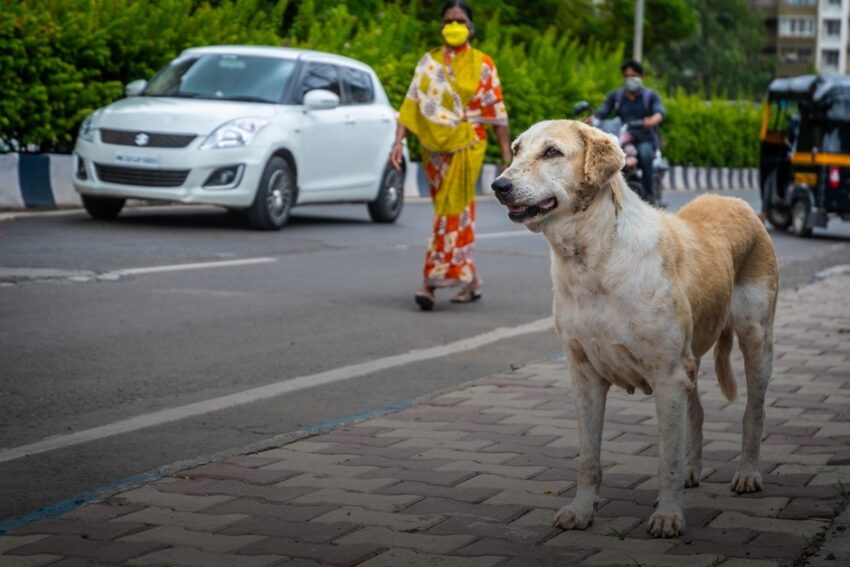
The dog has been watching from across the street. It sits on its hind-quarters. The word stoic comes to her mind, a word she associates with tales of sea captains and Russian authors like Dostoevsky. Its fur is white, spotted here and there with patches of dark brown. It watches her as Sanaa wanders back inside the store to deal with the growing line of customers. She doesn’t recall seeing this particular dog before, though that isn’t a surprise given the number of wild dogs that infest the city. Still, she can’t shake the feeling that there is something unnatural about the animal.
Not that she has time to ruminate on the matter. Mother is expecting her at home and she knows better than to keep mother waiting.
The store is only a few blocks from home, a familiar walk she’s made many times before though the bags aren’t usually so heavy. They slow her down as the items inside shift weight with each step, so she knows she can’t tarry.
It’s not until she turns onto their street that she sees the dog is following her. At some point it crossed to her side of the street, though it stays at a consistent distance. She has to turn her body one hundred eighty degrees in order to see it as the bags prevent her from simply turning her head. She’s standing there, looking back the way she’s just come, when a voice calls out for her.
Mother is at the door to their house with Grandfather, an arm raised up in the air to catch her attention. Frustration has knit mother’s brow into an ocean of creases. She hurries the rest of the way down the street and up the pathway. She braces herself for a slap that never comes. Instead, mother takes one of the bags from her and pushes her through the door. Mother’s about to close the door behind her when a white and brown shape darts over the threshold and into the house.
Mother screams, a blood-curdling cry unlike anything she’s ever heard before in her twelve years on this planet. The dog doesn’t make a sound, not even the scratch of claws against tile.
Mother rushes deeper into the house with Grandfather in tow, leaving her alone with the animal. It’s watching her with blue-green eyes, an almost inquisitive expression on its face. She wonders if it has a name, wonders if it will be up to her to name it though she knows they won’t keep the poor beast. She reaches down tentatively to give it a pat before pushing it out the door.
But mother has returned.
Mother must have gone into the kitchen, she realizes, because now the matron is wielding a wooden rolling pin.
She realizes too late what’s about to happen.
The first blow catches the dog on the head. There’s the sharp crack of bone as the animal collapses onto the tile. Her hand still out to pet the animal, she instinctually puts it up to prevent another strike.
Mother grabs her by the wrist and yanks hard. She lifts off the ground a foot and tumbles across the floor behind her progenitor.
She covers her eyes to avoid seeing the carnage her mother makes of the dog, but the sounds are inescapable. She cries hopelessly. Mother leaves her where she’s landed and goes to find a shovel to bury the beast. On hands and knees she crawls across the floor so she can take the animal’s head in her lap, try to give it some kind of comfort as its lungs struggle to take its last breath.
Mother calls her from the backyard. She tries to ignore the woman but the calls grow fierce. She knows what will happen to her if she refuses.
The shovel is missing. It takes them nearly ten minutes to discover the neighbor, Mr. Ramhani, has borrowed it without asking yet again.
The dog is missing when they return to the entryway. Mother’s breathing quickens. The shovel drops to the floor where it dances in a cacophony of rattles before it grows still.
Mother has her dig a hole in the backyard regardless. In it they toss the rags used to clean the blood. These are then lit on fire and the ashes are buried.
Afterward, life returns to normal. For the most part.
Now whenever she leaves the house Mother stands guard at the door. She is no longer allowed to enter on her own. First she must knock on the door and wait for mother to answer.
The door may only be opened enough to allow her to slip through, no further.
Grandfather’s sick.
He was never a particularly healthy individual having spent the last nine years of his life, as far back as she can remember, almost entirely confined to the upstairs bed. She can remember mother sitting her down on the couch to explain that Grandfather had a stroke. She didn’t understand what mother was saying, just that Grandfather was going to be spending a lot of time in bed.
As she aged, taking care of Grandfather became one of her prime responsibilities. It was her duty to change his clothing once every two days. She did so with a sponge and soapy water on hand to clean away the filth that accumulated. The sheets were changed once a month, washed in watered down bleach and then reapplied.
Another chore that fell to her was Grandfather’s feeding. After her and mother had eaten, she was to go upstairs with a plate for Grandfather and ensure that he ate it. He was no longer capable of eating on his own. It was up to her to open his mouth and push his teeth together until the food was mush. Then she would tilt his head back and wait for him to eventually swallow. Some days she was convinced she was choking her Grandfather, killing him on crushed potatoes and steamed carrots.
The only exception to Grandfather’s confinement was the weekly walk that mother would take him on. Mother felt that it was important that the neighbors see her actively engaging in the care of her elder. To mother, appearances mattered as much as blood. Inside the house, however, Grandfather was her responsibility not mother’s.
This meant that she was the first one to realize he was showing signs of fever, his frail body jerking in a parody of the shake.
Mother tells her there’s no money for the doctor and refuses to speak further on the matter.
Today is Grandfather’s funeral. It has only been a handful of days since she first noticed the sickness.
It didn’t take long for the illness to destroy the man. Mother blames the stroke for his death, not the sickness. She stands next to his body and tells those present that Grandfather has been dead for the last decade and that’s why she can’t bring herself to weep. Heads nod in agreement to this sage revelation.
It’s the first time mother has been outside since the incident with the dog.
They put Grandfather into the earth. Friends and family each throw a handful of dirt onto his casket. When they are alone mother has her fill in the rest with the shovel Mr. Ramhani keeps stealing.
It’s dark by the time she finishes. Mother complains, though the matron never offered any assistance with the task.
Her legs ache. She falls behind mother on the walk home. The moon is nearly full, just about reaching its zenith when they turn onto their street.
Mother opens the front door and steps through together with a little blurred shape by her ankles. If she hadn’t known better, she would have swore it was the same dog.
But there is no dog in the house when she enters and mother doesn’t show any concern or agitation.
Mother is raving. The woman hears howling from the walls.
For her part, she hears nothing but the tolling of the wind and the sounds of the street vendors outside.
Mother’s skin is pale. She has always seemed pale when compared to the neighbors, being the only white woman to live on their street, but now she is pale when compared to her own daughter.
Sweat has become mother’s constant companion, whether she is working or resting. Now she carries a rag in her pocket to dab mother’s forehead.
There is a smell in the house now.
It smells like Grandfather.
And mother, too.
Like grave flowers and rotten wood.
The scent of death.
Mother is screaming in a language she doesn’t recognize. With time she realizes it is English, mother’s first-language. But the words are unfamiliar. She can’t tell what mother wants.
Great sores have opened on mother’s face and hands. They ooze a yellowish-pink liquid that stains whatever it touches like Sanaa’s hands stained their grocery bags. The sores smell like wet dog and freshly spilled blood.
At her mother’s command, she has begun to tear open the walls. Mother wants the cause of her vexation to be found. The damnable beast that is howling in her head.
With a claw hammer she beats a hole into the boards and then pries them out. One by one they come free from the wood with great splintering noises. Inside is stale air, electrical wires, and mouse droppings.
There is no dog in the walls, only in mother’s head.
Mother is dead at the end of the hall where she’s fallen. She died flailing and thrashing at a beast only she could see.
The child stands before the corpse with a mixture of sadness and relief in her heart. The sores leak only blood.
They look like teeth marks.
She knows she should seek help, to ask Mr. Ramhani who needs to be informed.
But she has learned better than to step through the doorway and risk the admittance of unknown dogs across the threshold.
Discover more from Writing Darkness
Subscribe to get the latest posts sent to your email.